
If you have celiac disease or gluten intolerance, navigating food away from home — whether on a road trip, a domestic city break, or an international adventure — can feel stressful. With a little preparation, though, traveling gluten-free is entirely manageable, and often easier than you'd expect.
Celiac disease affects an estimated 1% of the global population, with non-celiac gluten sensitivity affecting up to 6% more. That growing prevalence means awareness has increased substantially in restaurants, markets, airports, and hotels worldwide. And because so many cuisines are built around naturally gluten-free ingredients — rice, grilled meat or fish, legumes, fresh produce, potatoes, and cooked vegetables — you often don't need a dedicated GF restaurant to eat safely and well.
Before You Go: Set Yourself Up for Success
Download These Three Apps
• Find Me Gluten Free — Find Me Gluten Free
The most widely used crowdsourced restaurant finder in the celiac community. Users rate celiac safety — dedicated fryers, cross-contamination practices, and whether a restaurant is truly celiac-safe vs. simply "gluten-aware." Free version covers most needs; paid upgrade unlocks the "most celiac-friendly" filter.
• Atly — Atly
A celiac safety-first app with 270,000+ locations globally and moderated reviews that distinguish between "gluten-free options," "celiac-accommodating," and "100% gluten-free." The GF map is premium, but a free trial is available.
• Gluten Free Scanner — Gluten Free Scanner
A barcode scanner for grocery stores. Scan any product to instantly check for hidden gluten sources. Covers 3M+ products, works offline (critical for international travel), and syncs when you reconnect.
Pro Tip
Search your destination in Find Me Gluten Free and Atly before you leave — not when you're hungry and standing on a street corner. Cross-check listings with a quick Google search to confirm the restaurant is still open, since app listings can be out of date.
What to Pack: Snacks and Backup Food
This is non-negotiable. Whether you're on a long flight, a food-included boat tour, a road trip, or a hilltop hike with one café, having food you trust in your bag removes the anxiety entirely. I learned this firsthand on a recent trip when the airline missed my gluten-free meal entirely — my snack bag became lunch.
• Nuts and seeds — naturally GF, calorie-dense, no refrigeration needed. Look for "produced in a dedicated GF facility" on the label if you're highly sensitive.
• GF oatmeal packets — add hot water from the hotel kettle, stir in a nut butter packet and fresh fruit, and breakfast is handled.
• Jerky or meat sticks — portable, shelf-stable, high protein. Always verify the label; seasonings can contain hidden gluten.
• Individual nut butter packets — pair with fruit, rice cakes, or celery sticks, or eat straight from the packet.
• GF crackers — shelf-stable and versatile. Most GF crackers are made with nuts, seeds, and alternative flours, which actually deliver more protein and fiber than standard wheat crackers.
• Canned fish packets — easy protein, lightweight, naturally GF. Avoid brands packed in "vegetable broth," which can contain hidden gluten.
• GF protein bars — always read the label. Look for the gluten-free callout on the package; don't assume.
• Fresh fruit and vegetables — grab at local markets along the way. Always naturally GF, and a great way to eat local.
✈ Smart Choices at the Airport
Airport food is unpredictable. Safe bets: Greek yogurt (plain, no granola unless labeled GF), eggs with vegetables, fruit cups, undressed salads, and rice-based dishes where you can verify the ingredients. Avoid anything fried in a shared fryer. When in doubt, reach for your snack bag — that's exactly what it's there for.
Eating Gluten-Free at Restaurants
Finding a dedicated GF restaurant is wonderful when it happens — but it's not the only way to eat safely. Across most cuisines, there are naturally gluten-free dishes hiding in plain sight on almost every menu. The key is knowing what to look for.
Mexican
Bean and cheese tacos or fish tacos in corn tortillas are almost always GF. Pair with corn tortilla chips, salsa, guacamole, and sour cream — all naturally gluten-free. Avoid flour tortillas and dishes with unknown marinades.
Classic American Breakfast
Eggs with bacon and fresh fruit is a reliable, naturally GF plate served almost anywhere. Ask for roasted potatoes or GF toast on the side. Skip the pancakes and standard toast unless GF options are clearly labeled.
Burgers and Grilled Meats
Burgers can always be ordered without a bun. Ask whether the kitchen adds soy sauce, Worcestershire, or breadcrumbs to their meat before forming — some do. Grilled chicken, steak, and BBQ meats are rarely prepared with gluten; order any dipping sauce on the side and verify.
Mediterranean and Greek
Grilled fish, roasted chicken, whole branzino, Greek salad dressed with olive oil you pour yourself, roasted potatoes, olives, feta. This is the cuisine. None of it needs a GF substitution.
Middle Eastern
Shawarma served with grilled vegetables and rice is often naturally GF. Lentil soup, lentil dahl, hummus, and grilled meats with rice or roasted vegetables are reliable choices. Confirm that pita or other bread is not used as a hidden ingredient, and verify that sauces are free of flours.
Charcuterie and Cheese Boards
Fresh fruit, olives, cured meats, and cheese are reliably safe in nearly every country. Order the board without crackers or ask for GF crackers on the side.
Rice-Based Dishes
Paella (Spain), rice bowls, and rice with beans (Latin American cuisine) are naturally GF — confirm the stock or broth used, which occasionally contains gluten.
The Universal Salad Hack
Salads are almost always customizable. Ask for no croutons and oil and vinegar on the side — this works in virtually every language and leaves you with a safe, satisfying plate. Avoid pre-made dressings when you can't read the label; olive oil and balsamic you pour yourself is the safest and often the best option anyway.
International Travel: Finding GF Options in Europe
Traveling internationally adds a layer of complexity — language barriers, unfamiliar ingredients, and kitchens that may not have the same cross-contamination awareness. The good news: many parts of the world are becoming genuinely easier for celiac travelers, and leaning into local naturally GF food is often the most delicious strategy anyway.
Request a GF Meal on Your Flight
Most major airlines offer a gluten-free meal option at booking or through your reservation settings. Do it — every time, without exception. Still bring your own backup food. Airlines make mistakes more often than you'd think, and a missed GF meal on a long international flight is not a great start.
Learn a Few Key Phrases
Good news: most languages use a word close to "gluten," so even a simple point-and-say gets you somewhere. Here are the phrases most useful for common travel destinations:
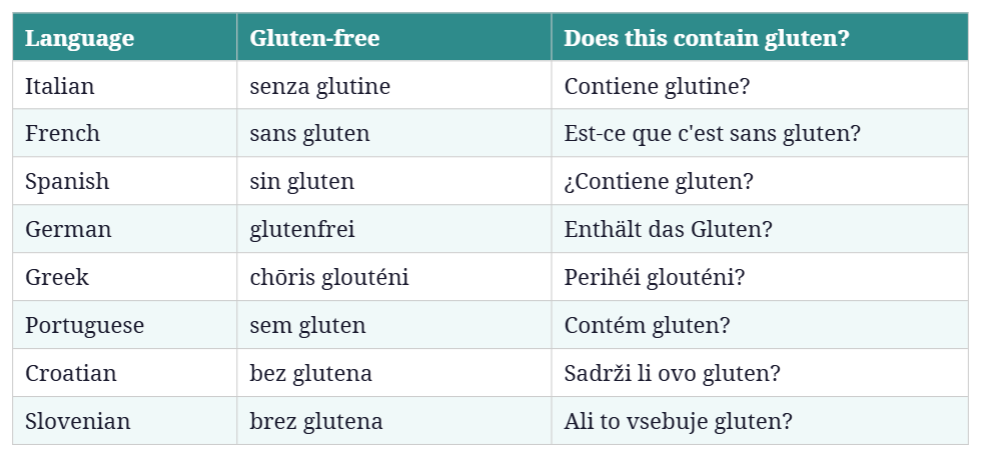
For complex itineraries or high sensitivity, a printed allergy translation card from Equal Eats or Gluten Free Passport covers 15+ languages and explains cross-contamination in detail. Worth every penny!
Use Your Apps Before You Land
Use Find Me Gluten Free and Atly to identify 2–3 safe options near where you're staying before you arrive. Read recent celiac travel blogs for city-specific recommendations — but always cross-check with Google to confirm the restaurant is still open. Blogs can be years out of date.
Shop Local Markets
Most European grocery stores carry EU-labeled GF products (look for the crossed grain symbol). Use Gluten Free Scanner to check unfamiliar packaged items. Even better: seek out a local outdoor market. Fresh fruit, vegetables, smoked fish, olives, cured meats, and fresh cheeses are everywhere and usually naturally GF — and delicious.
Plan Ahead for Tours and Small Towns
A quick search before visiting a remote site or joining a foodie tour is worth it. If GF options are scarce, pack your own. Tour companies get dietary requests wrong, and having something in your bag means the day isn't derailed.
✓ Your GF Travel Checklist
Before You Leave
☐ Download Find Me Gluten Free, Atly, and Gluten Free Scanner
☐ Search your destination for GF restaurant options
☐ Request a GF meal on your flights
☐ Pack snacks for the plane, layovers, and day trips
☐ Print or download allergy translation cards for your destinations
When You Arrive
☐ Find a local market; use Gluten Free Scanner to check packaged items
☐ Identify 2–3 GF-friendly restaurants near your accommodation
☐ Learn "no gluten" in the local language
☐ Ask about shared fryers at any restaurant serving fried food
On Every Tour or Excursion
☐ Pack your snack bag regardless of whether a meal is included
☐ Confirm GF meal requests 24 hours before any food-included event
The Bottom Line
Celiac disease and gluten intolerance don't have to define your travel experience — or limit it. Better restaurant awareness, naturally GF cuisines, powerful apps, and a well-packed snack bag mean you can eat well, eat safely, and fully enjoy the food culture of wherever you are.
Prepare a little before you go, stay curious about local food rather than afraid of it, and keep something you trust in your bag at all times.
Cristen Benz, MS, RDN is a registered dietitian in private practice at Benz Wellness in Fort Collins, Colorado. She specializes in GLP-1 success, weight loss, women’s health, gut health, and autoimmune conditions. She works individually with clients to build practical, customized ways of eating that fit real life. She also works with organizations to provide resources and guidance so employees are more productive, focused, and feeling healthy. Learn more at benzwellness.com.
